Sexually transmitted infections and screening for chlamydia in England: 2021 report - GOV.UK
- UK Health
Security
Agency
Updated 4 October 2022

© Crown copyright 2022
This publication is licensed under the terms of the Open Government Licence v3.0 except where otherwise stated. To view this licence, visit nationalarchives.gov.uk/doc/open-government-licence/version/3 or write to the Information Policy Team, The National Archives, Kew, London TW9 4DU, or email: psi@nationalarchives.gov.uk.
Where we have identified any third party copyright information you will need to obtain permission from the copyright holders concerned.
This publication is available at https://www.gov.uk/government/statistics/sexually-transmitted-infections-stis-annual-data-tables/sexually-transmitted-infections-and-screening-for-chlamydia-in-england-2021-report
The annual official statistics data release (data to end of December 2021).
1. Main points
This report provides a descriptive analysis of data on sexually transmitted infection (STI) diagnoses and screening for chlamydia in England from January to December 2021. In response to coronavirus (COVID-19), the UK government implemented strict non-pharmaceutical interventions (NPIs) in the form of national and regional lockdowns and social and physical distancing measures from March 2020; these NPIs resulted in disruption to the delivery of sexual health services (SHSs). Many of the NPIs remained in place at the start of 2021 and continued to impact the delivery of SHSs.
However, SHSs continued to diagnose hundreds of thousands of STIs after scaling up telephone and internet consultations, as well as continuing face-to-face appointments. While there has been some recovery in the number of consultations and tests compared to 2020, numbers remain lower compared to the period before the COVID-19 pandemic. This report primarily focuses on the trend between 2020 and 2021, but data on tests and diagnoses between 2012 and 2021 are available in the accompanying data tables and slide set, as well as the Sexual and Reproductive Health Profiles.
The main points of this report are as follows:
- in 2021, there was a total of 4,002,827 consultations at SHSs, a 15.7% increase compared to 2020 and an increase of 3.9% since 2019
- in 2021, there were 1,949,940 sexual health screens (diagnostic tests for chlamydia, gonorrhoea, syphilis, and human immunodeficiency virus (HIV) delivered by SHSs, an increase of 18.7% compared to 2020, but 13.2% decrease relative to 2019
- in 2021, there were 311,604 diagnoses of new STIs among England residents, a similar number compared to 2020 (0.5% increase from 309,921) and a decrease of 33.2% since 2019
- there were 51,074 diagnoses of gonorrhoea reported in 2021, a 1.7% increase compared to 2020
- there were 7,506 diagnoses of infectious (primary, secondary, early latent) syphilis reported in 2021, an 8.4% increase compared to 2020
- the impact of STIs remains greatest in young people aged 15 to 24 years, certain Black ethnic groups, and GBMSM
Through the National Chlamydia Screening Programme (NCSP):
- 978,307 chlamydia tests were carried out among young people aged 15 to 24 years in 2021, a 4% increase compared to 2020
- there were 87,905 chlamydia diagnoses in this age group, a decrease of 5% compared to 2020; test positivity decreased from 9.8% to 9.0%
- the proportion of chlamydia tests delivered through internet services increased from 40% in 2020 to 43% in 2021; the proportion of diagnoses made through these services increased from 36% to 40% over the same period
2. Main STI prevention messages
Providers and commissioners have an important role in communicating messages about safer sexual behaviours and how to access services – main prevention messages include:
- using condoms consistently and correctly protects against HIV and other sexually transmitted infections (STIs) such as chlamydia, gonorrhoea, and syphilis; and can prevent unplanned pregnancy
- regular screening for STIs and HIV is essential to maintain good sexual health – everyone should have an STI screen, including an HIV test, on at least an annual basis if having condomless sex with new or casual partners – and in addition:
- women and other people with a womb or ovaries under the age of 25 who are sexually active should have a chlamydia test annually and on change of sexual partner
- gay, bisexual and other men who have sex with men (GBMSM), should have an annual test for HIV and STIs or every 3 months if having condomless sex with new or casual partners
- HIV pre-exposure prophylaxis (PrEP) can also be used to provide protection to people at risk of HIV while HIV post-exposure prophylaxis (PEP) can be used after condomless sex if someone has potentially been exposed to HIV, to reduce the risk of contracting HIV; both can be obtained from specialist SHSs
- people living with diagnosed HIV who are on treatment and have an undetectable viral load are unable to pass on the infection to others during sex; this is known as 'Undetectable = Untransmittable' or 'U=U'
- vaccination against monkeypox virus, human papillomavirus (HPV), hepatitis A and hepatitis B will protect against disease caused by these viruses and prevent the spread of these infections:
- GBMSM can obtain the monkeypox, hepatitis A and hepatitis B vaccines from specialist sexual health services; these vaccines are also available for other people at high risk of exposure to the viruses
- GBMSM aged up to and including 45-years-old, can also obtain the HPV vaccine from specialist SHSs
- SHSs are free and confidential and offer testing and treatment for HIV and STIs, condoms, vaccination, HIV PrEP, and PEP:
- online self-sampling for HIV and STIs is widely available
- information and advice about sexual health including how to access services is available at Sexwise and from the national sexual health helpline on 0300 123 7123
3. Overall trends in consultations, STI testing and diagnoses at SHSs among England residents
Overall, there was an increase in the number of consultations delivered by SHSs in 2021 compared to 2020 (15.7%; from 3,460,100 to 4,002,827). Of all consultations in 2021, 49.8% (1,995,271) were delivered face-to-face; 35.8% (1,432,557) via the internet and 14.4% (574,999) via telephone. Compared to 2020, the number of face-to-face consultations in 2021 decreased by 2.5% (from 2,046,592 to 1,995,271). Compared to 2020, increases were seen in the number of internet (37.1%; from 1,045,039 to 1,432,557) and telephone consultations (56.1%; from 368,469 to 574,999). The number of internet consultations may be underreported as it only includes consultations provided by standalone internet SHSs and not those provided through STI self-sampling kits provided through the websites of physical SHSs.
The number of sexual health screens (tests for chlamydia, gonorrhoea, syphilis and HIV) in 2021 increased by 18.7% (from 1,642,598 to 1,949,940) compared to 2020. Compared to 2020 (309,921), the total number of new STIs diagnosed in 2021 (311,604) remained relatively constant (Figure 1). Similar to the distribution of STIs diagnosed in 2020, the most commonly diagnosed STIs in 2021 were chlamydia (159,448; 51.2% of all new STI diagnoses), gonorrhoea (51,074; 16.4%), first episode genital warts (28,280; 9.1%), and first episode genital herpes (21,649; 7.0%).
Between 2020 and 2021, there was a small decrease in the number of chlamydia diagnoses (1.2%; from 161,373 to 159,448) and a small increase in diagnoses of gonorrhoea (1.7%; from 50,233 to 51,074), first episode genital warts (3.1%, from 27,432 to 28,280), and first episode genital herpes (5.5%; from 20,516 to 21,649). There was a marked increase (8.4%; from 6,923 to 7,506) in the number of diagnoses of infectious syphilis (primary, secondary and early latent stages), such that diagnoses of infectious syphilis have nearly returned to pre-pandemic levels and in some regions have exceeded them. The increase is particularly driven by asymptomatic (early latent) diagnoses, but there has also been a notable increase in diagnoses of neurosyphilis. Trends in diagnoses of STIs since 2012 are presented in Appendix Figure A2.
Figure 1: Number of new STI diagnoses and sexual health screens among England residents accessing sexual health services, 2012 to 2021

Data from routine returns to the GUMCAD STI and CTAD Chlamydia Surveillance Systems, sexual health screen-tests for chlamydia, gonorrhoea, syphilis or HIV.
*The 'New STI diagnoses' group was expanded in 2015 to include STI diagnoses not previously reported via GUMCAD (Shigella and Mycoplasma genitalium infections). Therefore, counts of new STIs before and after 2015 are not directly comparable.
‡Data reported in 2020 and 2021 are notably lower than previous years due to the reconfiguration of SHSs during the national response to the COVID-19 pandemic.
3.1 STI epidemiology in populations with greater sexual health needs
3.1.1 Black ethnic groups
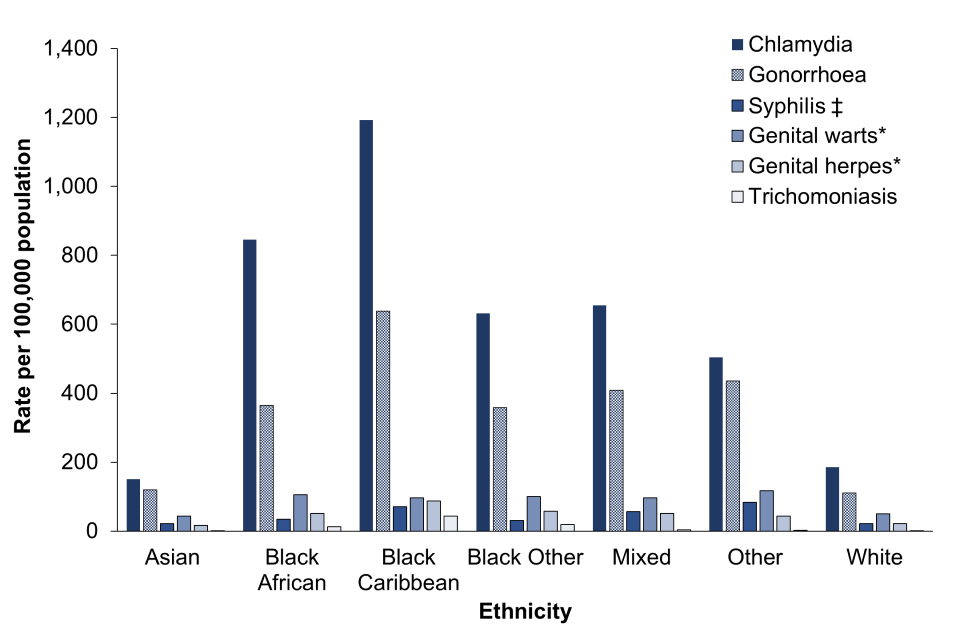
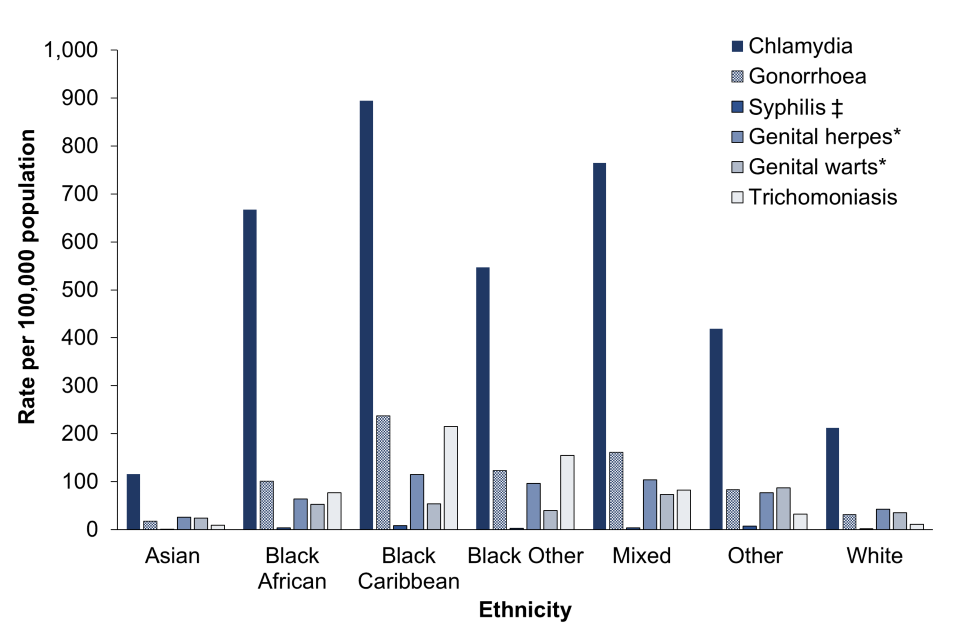
Of all ethnic groups, the population rates of STI diagnoses remained highest among people of Black ethnicity in 2021, but this varied amongst Black ethnic groups. In 2021, people of Black Caribbean ethnicity had the highest diagnosis rates of chlamydia, gonorrhoea, herpes, and trichomoniasis, while people of Black African ethnicity had relatively lower rates than other ethnic groups (Figure 2a, Figure 2b). Research conducted through the Health Protection Research Unit (HPRU) on blood-borne and sexually transmitted infections in 2017 to 2018 found, when compared to all other ethnic groups, there were no unique clinical or behavioural factors explaining the disproportionately high rates of STI diagnoses among people of Black Caribbean ethnicity; this ethnic disparity in STIs is likely influenced by underlying socioeconomic factors and the role they play in the structural determinants of the health of this community (1).
Figure 2. Rates of selected STI diagnoses among England residents accessing sexual health services by ethnicity and STI, 2021
(a) Women
Data from routine sexual health services' returns to the GUMCAD STI Surveillance System.
(b) Men
Data from routine sexual health services' returns to the GUMCAD STI Surveillance System.
‡Primary, secondary and early latent.
*First episode.
The ethnic categories above are as specified by the Office for National Statistics (ONS). Data is presented by disaggregated ethnic groups among people of Black ethnicity to highlight the variability in rates among the ethnic group experiencing the highest rates of the most commonly diagnosed STIs. People of Asian, Mixed, Other and White ethnicity are presented as aggregated ethnic groups for comparison (2).
3.1.2 Gay, bisexual and other men who have sex with men
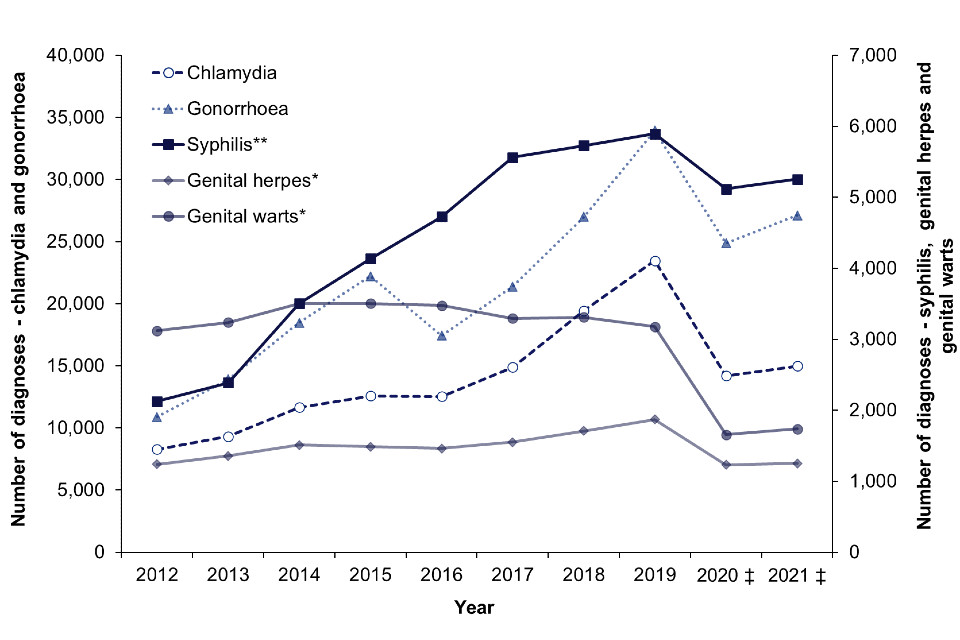
Between 2012 and 2019, the number of bacterial STI diagnoses among GBMSM increased persistently before dropping in 2020. While some of this increase in the early part of the decade was likely due to increased testing, it may also be attributed to ongoing high-risk sexual behaviour (3, 4). In keeping with the recovery of service provision and increased STI testing in 2021, there were increases in STI diagnoses in GBMSM between 2020 and 2021: diagnoses of gonorrhoea increased by 9.0% (24,784 to 27,123), chlamydia increased by 5.5% (14,191 to 14,980), diagnoses of infectious syphilis increased by 2.6% (from 5,118 to 5,254) (Figure 3). Note that due to incomplete reporting of some sexual orientation data in 2021, numbers for GBMSM that are presented in this paragraph and in Figure 3 have been adjusted. Full details are provided in the 'Technical note' in the Appendix.
Figure 3. Number of new diagnoses of selected sexually transmitted infections among gay, bisexual and other men who have sex with men accessing sexual health services, 2012 to 2021†, England
Data from routine sexual health services' returns to the GUMCAD STI Surveillance System.
*First episode.
**Includes diagnoses of primary, secondary, and early latent syphilis.
‡Data reported in 2020 and 2021 are notably lower than previous years due to the reconfiguration of SHSs during the national response to the COVID-19 pandemic.
†The number of STI diagnoses in GBMSM in 2021 was adjusted to account for incomplete reporting of some sexual orientation data (see 'Technical note' in the Appendix for more details).
The National HPV Vaccination Programme for GBMSM aged up to and including 45 years attending specialist SHSs and HIV clinics started across England in April 2018 following a 2 year pilot. To the end of 2021, 37.2% of eligible attendees have started their 3 dose HPV vaccine course, and of these, 58.3% have received at least 2 doses. There was a decline in GBMSM eligible for vaccination attending SHSs during the COVID-19 pandemic, but this has begun to recover throughout 2021.
3.1.3 Young people aged 15 to 24
Young people experience the highest diagnosis rates of the most common STIs, and this may be due to higher rates of partner change among 16- to 24-year-olds (5). Young women may be more likely to be diagnosed with an STI due to disassortative sexual mixing by age and gender (6). Compared to 2020, the number of new STI diagnoses in 2021 among young people aged 15 to 24 years decreased by 5.8% (from 141,573 to 133,342). There was a large decrease in diagnoses of first episode genital warts (21.7%; from 9,600 to 7,516), with smaller decreases seen in diagnoses of gonorrhoea (7.4%; from16,351 to 15,143) and chlamydia (5.1%; from 92,680 to 87,905). There was a small increase in the number of diagnoses of first episode genital herpes (2.8%; from 7,947 to 8,915) and a larger proportional increase was observed for infectious syphilis (6.1%, from 908 to 963). It is not yet clear the extent to which the decreases observed relate to a fall in the incidence of these infections in the community.
In 2021, the rate of first episode genital warts diagnoses among young women aged 15-to-17 years attending SHSs, most of whom would have been offered the quadrivalent HPV vaccine (protecting against HPV types 16, 18, 6 and 11) aged 12 to 13, was 84.9% lower compared to 2017 (7.4 vs 49.1 per 100,000 population). A decline of 80.0% (4.1 vs 20.3 per 100,000 population) was seen in heterosexual young men of the same age over the same period, suggesting substantial herd (or indirect) protection. These declines were also seen in 18-to-20-year-olds and 21-to-24-year-olds. These are all age groups with direct or herd or indirect protection from the quadrivalent HPV vaccine. A substantial decline of 69.8% (35.7 vs 118.3 per 100,000 population) was seen in GBMSM aged 15-to-17 years, which is likely due to both protection from vaccination of young GBMSM in SHSs and continuing herd protection from the adolescent programme.
4. National Chlamydia Screening Programme
4.1. National trends
The primary aim of the National Chlamydia Screening Programme (NCSP) is to reduce the health harm caused by untreated chlamydia infection. The programme has the secondary aims of reducing re-infections and onward transmission of chlamydia and raising awareness of good sexual health. Opportunistic screening (that is the proactive offer of a chlamydia test to young people without symptoms) should focus on women, combined with reducing time to test results and treatment, strengthening partner notification and re-testing after treatment; 'women' also includes people with a womb or ovaries include such as transgender men, and non-binary people assigned female at birth, and intersex people with a womb or ovaries. Services provided by SHSs, which include chlamydia testing as part of routine sexual health checks at any age remain unchanged.
This report relates to 2021, for the most part of which the NCSP offered screening to all young people under 25 years. As chlamydia is a largely asymptomatic infection, increases in the number of infections detected and treated is an indication of improved chlamydia control.
In 2021, an estimated 978,307 chlamydia tests were carried out in England among young people aged 15 to 24 years. An estimated 14.8% of young people (21.8% of young women and 7.6% of young men) (Table 1a, Table 1b) were tested for chlamydia. A total of 87,905 chlamydia diagnoses were made among this age group, equivalent to a detection rate of 1,334 per 100,000 population aged 15 to 24.
The number of chlamydia tests carried out through the NCSP in 2021 (978,307) was 3.8% higher than in 2020 (942,829) (Table 2a). However, there was a 5.2% decrease in the number of diagnoses made in 2021 (87,905) compared to 2020 (92,680) (Table 2b). The detection rate decreased by 5.2% in 2021 (1,334 per 100,000) compared to 2020 (1,407 per 100,000) (Figure 4). Test positivity decreased to 9.0% in 2021 compared to 9.8% in 2020 (Table 2c).
Table 1. Chlamydia tests, diagnoses, testing coverage and test positivity among 15- to 24-year-old women and men, 2020 and 2021, England
(a) Women
| Indicator | 2020 | 2021 |
|---|---|---|
| Total tests | 676,675 | 695,937 |
| Total diagnoses | 60,140 | 56,315 |
| Coverage | 21.20% | 21.80% |
| Test positivity | 8.90% | 8.10% |
Data from laboratory returns to the CTAD Chlamydia Surveillance System
(b) Men
| Indicator | 2020 | 2021 |
|---|---|---|
| Total tests | 255,172 | 258,764 |
| Total diagnoses | 30,938 | 29,173 |
| Coverage | 7.50% | 7.60% |
| Test positivity | 12.10% | 11.30% |
Data from laboratory returns to the CTAD Chlamydia Surveillance System.
Figure 4. Chlamydia testing coverage, detection rates and test positivity among 15- to 24-year-olds, 2017 to 2021, England

Data from laboratory returns to the CTAD Chlamydia Surveillance System.
‡Data reported in 2020 and 2021 are notably lower than previous years due to the reconfiguration of SHSs during the national response to the COVID-19 pandemic.
*Public Health Outcomes Framework.
4.2. Characteristics of people screened for chlamydia
The number of chlamydia tests and diagnoses was higher among young women than young men, with young women accounting for 71.1% of all tests and 64.1% of all diagnoses in 2021. Positivity among young women was lower than among young men (8.1% vs 11.3%) (Table 1a, Table 1b).
By ethnicity, the majority of testing occurred among those of White ethnicity, accounting for 57.7% (564,932) of all tests in 2021 Figure 5a). Diagnoses were also highest among those of White ethnicity, with 51,318 diagnoses in 2021, accounting for 58.4% of diagnoses. The distribution of tests and diagnoses is influenced by the underlying population distribution of young people by ethnicity (7). Positivity was highest among those of Black 'Other' (non-African or -Caribbean) ethnicity (12.9%; 981 out of 7,603) followed by those of Black Caribbean ethnicity (12.5%; 3,485 out of 27,801) compared to those of White ethnicity (9.1%; 51,318 out of 564,932) (Figure 5b).
Figure 5. Chlamydia tests and test positivity* among 15- to 24-year-olds by ethnicity**, 2017 to 2021, England
(a) Number of tests

Data from laboratory returns to the CTAD Chlamydia Surveillance System.
*The distribution of tests and diagnoses is influenced by the underlying population distribution of young people by ethnicity.
**The ethnic categories above are as specified by the Office for National Statistics (ONS).
‡Data reported in 2020 and 2021 are notably lower than previous years due to the reconfiguration of SHSs during the national response to the COVID-19 pandemic.
(b) Test positivity

Data from laboratory returns to the CTAD Chlamydia Surveillance System.
*The distribution of tests and diagnoses is influenced by the underlying population distribution of young people by ethnicity.
**The ethnic categories above are as specified by the Office for National Statistics (ONS).
‡Data reported in 2020 and 2021 are notably lower than previous years due to the reconfiguration of SHSs during the national response to the COVID-19 pandemic.
Chlamydia testing and diagnoses differ by level of socioeconomic deprivation. Deprivation is measured using the index of multiple deprivation (IMD), a residential area-level measure of socioeconomic status. The first (Q1) quintile represents the most deprived 20% of geographical areas and the fifth (Q5) quintile the least deprived 20%. The chlamydia detection rate differed by IMD quintile for both women and men. In 2021, chlamydia detection rates were highest among those living in Q1 (most deprived quintile) in England (2,206 per 100,000 for women and 1,046 per 100,000 for men). Rates were lowest among those living in Q5 (least deprived quintile) in England (1,073 per 100,00 for women and 581 per 100,000 for men). The detection rate decreased across all quintiles for both men and women between 2020 and 2021 (Figure 6a, Figure 6b).
Figure 6. Chlamydia detection rates among 15- to 24-year-olds by IMD quintile* in women and men, 2020 and 2021, England
(a) Women

Data from laboratory returns to the CTAD Chlamydia Surveillance System.
(b) Men

Data from laboratory returns to the CTAD Chlamydia Surveillance System.
*NCSP data presented by IMD quintile is based on the location of residence of the person tested.
4.3. Testing service type
The number of tests conducted in a physical (face-to-face) setting was 2.4% lower in 2021 (556,109) compared to 2020 (569,644). There was a 13.1% increase in the testing conducted using self-sampling kits via the internet between 2020 (373,185) and 2021 (422,198) (Figure 7, Table 2) (see the 'Data sources' section of the Appendix for further information on the different types of testing services).
Figure 7. Chlamydia tests from internet and face to face* testing and total diagnoses among 15- to 24-year-olds, 2017 to 2021, England

Data from laboratory returns to the CTAD Chlamydia Surveillance System.
*Face to face testing includes sexual health services, GP, Pharmacy, ToP, Unknown, and Other.
‡Data reported in 2020 and 2021 are notably lower than previous years due to the reconfiguration of SHSs during the national response to the COVID-19 pandemic.
While testing declined in other testing services, tests from internet services increased by 13.1% in 2021 (Table 2a). This large increase in internet testing reflects the scaling up of online sexual healthcare provision across England in 2020. While increases in the number of internet tests were seen in majority of UKHSA regions in 2021, the proportion increase was largest in those residing in the North West (51.5% increase; 10,883 more tests), the North East (25.7% increase; 14,247 more tests) and the East Midlands (18.5% increase; 6,975 more tests).
Table 2. Chlamydia tests, diagnoses, and test positivity among 15- to 24-year-olds by test setting, 2020 to 2021, England
(a) Testing
| Test setting | Number of tests in 2020 | % of total in 2020 | Number of tests in 2021 | % of total in 2021 | % change 2020 to 2021 |
|---|---|---|---|---|---|
| SHSs (specialist STI-related care) | 281,370 | 29.8 | 266,221 | 27.2 | -5.4 |
| SHSs (non-specialist STI-related care) | 23,844 | 2.5 | 17,550 | 1.8 | -26.4 |
| Internet | 373,185 | 39.6 | 422,198 | 43.2 | 13.1 |
| GP | 137,123 | 14.5 | 133,294 | 13.6 | -2.8 |
| Pharmacy | 7,373 | 0.8 | 5,763 | 0.6 | -21.8 |
| Termination of pregnancy (ToP) | 8,717 | 0.9 | 4,749 | 0.5 | -45.5 |
| Unknown | 13,647 | 1.4 | 11,769 | 1.2 | -13.8 |
| Other | 97,570 | 10.3 | 116,763 | 11.9 | 19.7 |
| Total | 942,829 | 100 | 978,307 | 100 | 3.8 |
Data from laboratory returns to the CTAD Chlamydia Surveillance System.
(b) Diagnoses
| Test setting | Number of diagnoses in 2020 | % of total in 2020 | Number of diagnoses in 2021 | % of total in 2021 | % change 2020 to 2021 |
|---|---|---|---|---|---|
| SHSs (specialist STI-related care) | 38,414 | 41.4 | 33,487 | 38.1 | -12.8 |
| SHSs (non-specialist STI-related care) | 2,825 | 3 | 1,861 | 2.1 | -34.1 |
| Internet | 32,903 | 35.5 | 35,379 | 40.2 | 7.5 |
| GP | 7,872 | 8.5 | 6,442 | 7.3 | -18.2 |
| Pharmacy | 836 | 0.9 | 594 | 0.7 | -28.9 |
| ToP | 708 | 0.8 | 327 | 0.4 | -53.8 |
| Unknown | 992 | 1.1 | 714 | 0.8 | -28 |
| Other | 8,130 | 8.8 | 9,101 | 10.4 | 11.9 |
| Total | 92,680 | 100 | 87,905 | 100 | -5.2 |
Data from laboratory returns to the CTAD Chlamydia Surveillance System.
(c) Test positivity
| Test setting | Test positivity 2020 (%) | Test positivity 2021 (%) |
|---|---|---|
| SHSs (specialist STI-related care) | 13.7 | 12.6 |
| SHSs (non-specialist STI-related care) | 11.8 | 10.6 |
| Internet | 8.8 | 8.4 |
| GP | 5.7 | 4.8 |
| Pharmacy | 11.3 | 10.3 |
| ToP | 8.1 | 6.9 |
| Unknown | 7.3 | 6.1 |
| Other | 8.3 | 7.8 |
| Total | 9.8 | 9 |
Data from laboratory returns to the CTAD Chlamydia Surveillance System.
4.4. Geographic variations
Chlamydia testing coverage, detection rate and test positivity varied by UKHSA region of residence. In 2021:
- chlamydia testing coverage among young people ranged from 10.9% in West Midlands to 20.8% in London
- test positivity ranged from 7.8% in the South West to 10.3% in the West Midlands
- the detection rate per 100,000 population aged 15 to 24 ranged from 1,079 in the South West to 1,673 in London
Differences in detection rate could be due to a combination of differences in overall chlamydia testing coverage, variations in the settings used to offer chlamydia testing, the underlying prevalence of infection, and variations in level of disruption to the screening programme due to COVID-19, including an increase in online self-sampling kits. Data on chlamydia detection rates at upper-tier local authority level is available in the Sexual and Reproductive Health Profiles.
5. Conclusions
Following the disruptions in service delivery during the first year of the COVID-19 pandemic, the number of consultations at SHS increased between 2020 and 2021 and now exceeds the number reported in 2019; this provides evidence of a recovery in service provision, after the lifting of COVID-19 restrictions in the summer of 2021, partially driven by the continued widespread provision of online consultations. The number of sexual health screens (for chlamydia, gonorrhoea, syphilis and HIV) in England also increased between 2020 and 2021, although the number of STI diagnoses remained stable. The increase in sexual health screens may be a result of built-up demand for SHSs as well as a return to pre-COVID-19 pandemic levels of social and sexual mixing and the substantial number of tests being accessed through online services (8 to 11). It will remain important to continue to monitor and understand whether these changes have affected equity of access to SHS (12, 13).
Chlamydia continues to account for the majority of STI diagnoses made in 2021, a large proportion of which are related to the National Chlamydia Screening Programme. Screening rates for chlamydia have recovered gradually since the pandemic, with an increasing proportion of tests and diagnoses being made via internet services.
Although overall STI diagnoses rates remained similar between 2020 and 2021, there was an increase in bacterial STI diagnoses among GBMSM. STIs continue to show geographic and socioeconomic variation and disproportionately impact GBMSM, people of Black Caribbean ethnicity, and young people aged 15 to 24 years.
References
1. Bardsley M, Wayal S, Blomquist P, Mohammed H, Mercer CH, Hughes G. 'Improving our understanding of the disproportionate incidence of STIs in heterosexual-identifying people of black Caribbean heritage: findings from a longitudinal study of sexual health clinic attendees in England' Sexually Transmitted Infections. 2022; volume 98: pages 23 to 31 (accessed 17 August 2022)
2. '2001 to 2011 Census in England and Wales Questionnaire Comparability'. December 2012, Office for National Statistics (accessed 1 August 2022)
3. Kirby, T. 'Record highs of sexually transmitted infections in UK's MSM'. The Lancet Infectious Diseases. 2014; volume 14 issue 1; page 16 to 17 (accessed 24 August 2022)
4. Mohammed H, Mitchell H, Sile B, Duffell S, Nardone A, Hughes G. 'Increase in 'Sexually Transmitted Infections among Men Who Have Sex with Men, England, 2014'. Emerging Infectious Diseases. January 2016; Volume 22 issue 1; page 88 to 91 (accessed 24 August 2022)
5. Mercer CH, Tanton C, Prah P and others. 'Changes in sexual attitudes and lifestyles in Britain through the life course and over time: Findings from the National Surveys of Sexual Attitudes and Lifestyles (Natsal)'. Lancet 2013: volume 382, pages 1781 to 1794 (accessed 12 July 2022)
6. Geary RS, Copas AJ, Sonnenberg P, Tanton C, King E, Jones KG, Trifonova V, Johnson AM, Mercer CH. 'Sexual mixing in opposite-sex partnerships in Britain and its implications for STI risk: findings from the third National Survey of Sexual Attitudes and Lifestyles (Natsal-3)'. International Journal of Epidemiology. February 2019: volume 48 issue 1: pages 228 to 242 (accessed 24 August 2002)
7. Office for National Statistics (ONS). 'Population estimates by ethnic group and religion, England and Wales: 2019'. December 2021 (accessed 11 August 2022)
8. Mitchell KR, Shimonovich M, Bosó Pérez R, Dema E, Clifton S, Riddell J and others. 'Initial Impacts of COVID-19 on sex life and relationship quality in steady relationships in Britain: Findings from a large, quasi-representative Survey (Natsal-COVID)'. The Journal of Sex Research. March 2022, pages 1 to 12 (accessed 11 August 2022)
9. Howarth A, Saunders J, Reid D, Kelly...
Popular posts from this blog
Effect of a board game on imprisoned women's knowledge about ... - BMC Public Health

Herpes Simplex: Two Types, Comparison Chart, Prevention - Verywell Health

The 5 Best OTC Cold Sore Treatments of 2024 - Health.com

Comments
Post a Comment